
Promoting Taekwondo in Rwanda
Kukkiwon Dispatch Master Ji-man Jeong
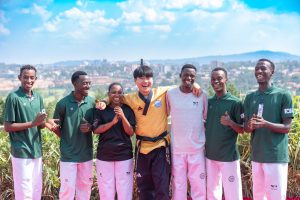
He has dedicated his life to Taekwondo, starting at the age of five and now working tirelessly to promote the Korean martial art in Rwanda: Kukkiwon Dispatch Master Ji-man Jeong is national coach, technical chairman, and influential instructor. He is helping Taekwondo flourish in East Africa through competitions, seminars, and regular classes in schools. In this interview, he shares his journey, experiences, achievements, and hopes for Taekwondo’s future in Rwanda.
Personal Background and Taekwondo Beginnings
Taekwondo Aktuell: Could you tell us about your early Taekwondo biography, before you became a Kukkiwon Dispatch Master?
Master Ji-man Jeong: I was born on 28 July 1988 in Daejeon, South Korea, where I lived until high school. I started Taekwondo at five years old after my father, who had four daughters before me, took me to a dojang. He was worried I might become too “girlish,” so he introduced me to Taekwondo—and I’ve been practising it now for 32 years.
From the fourth grade of elementary school until high school, I competed in various tournaments and represented my school. Later, I joined the Taekwondo Department at Gachon University and became a member of the demonstration team. After graduating, I taught Taekwondo at an alternative school, both as a regular class and as an after-school demonstration team, while simultaneously earning my master’s degree in physical education through night classes.
Eventually, I served my mandatory military duty via KOICA, an alternative service, which sent me to Rwanda in February 2014. I spent 30 months in the programme—two months of training in Korea and 28 months of service in Rwanda. After returning home in 2016, I resumed teaching at the alternative school.
Taekwondo Aktuell: What were some of the unique experiences you had when you first started practising Taekwondo professionally?
Master Ji-man Jeong: I remember my first tournament in the fourth grade of elementary school, where I won a bronze medal. Back then, tournaments were extremely popular, and I competed alongside over 100 other athletes in the flyweight division. I continued competing through elementary, middle, and high school. Although I received scouting offers from elite schools in Daejeon, I remained a gym athlete at my local school.
At the same time, I joined a local demonstration team on weekends, which led me to discover my love for demonstration. At Gachon University, I joined the demonstration team formally and set a goal to become a member of the Kukkiwon Demonstration Team—the highest level. After much effort, I achieved that goal and travelled worldwide for two years as a member of that team. Hence, I have experienced both competitive and demonstration sides of Taekwondo.
“I fell in love with the demonstration and had a goal to become a member of the Kukkiwon Demonstration Team, the highest level.”
— Master Ji-man Jeong
Taekwondo Aktuell: Why did you decide to pursue Taekwondo as a profession?
Master Ji-man Jeong:
I started Taekwondo at age five, so it has always been part of my life. I really enjoyed training, competing, and demonstrating, which naturally led me to major in Taekwondo so I could learn it more deeply and professionally.
Leaving Korea to Teach Abroad
Taekwondo Aktuell: Why did you decide to leave Korea and teach Taekwondo overseas?
Master Ji-man Jeong: In junior high school, we had an assignment to write about ourselves 20 years in the future. I declared I wanted to represent the national Taekwondo team internationally.
Just one year later, in high school, I was able to make my dream become true and began travelling abroad at least once a year to promote Taekwondo. I realised how the name “Taekwondo” unites people around the world, transcending language, culture, and religion. This profound unity drew me to teach Taekwondo overseas.
Taekwondo Aktuell: What countries did you stay in before coming to Rwanda, and what were your experiences?
Master Ji-man Jeong: I travelled briefly, one to two weeks, to various countries for demonstrations and competitions: China, Japan, Hong Kong, Taiwan, Russia, the Philippines, Indonesia, Turkiye, Egypt, Israel, France, Germany, the Netherlands, Italy, and the U.S.
I also spent more than a month in the U.S. during high school, living in Alabama and training Taekwondo in a homestay. In my first year of university, I taught Taekwondo at the Korean Cultural Centre in Ukraine for three months. Later, in 2017 to 2018, I joined the Global Sports Talent Development Programme supported by the KSPO (National Sports Promotion Foundation) at Florida State University, where I studied English, took professional sports lectures, and continued Taekwondo training. As I already mentioned, I coached the national Taekwondo team in Rwanda for 28 months as part of my KOICA service.
“Despite different languages, cultures, and religions, the name ‘Taekwondo’ unites people from all over the world.”
— Master Ji-man Jeong
Becoming a Kukkiwon Dispatch Master
Taekwondo Aktuell: Could you share how your KOICA recruitment in 2013 led from building Rwanda’s first indoor gym to returning on holiday and eventually making Rwanda your home as a Kukkiwon instructor?
Master Ji-man Jeong: In December 2013, the final KOICA military recruitment took place, and I passed the exam and was sent to Rwanda. I arrived there in February 2014 and served as a national coach until June 2016. During that time, I traveled throughout Rwanda demonstrating and teaching Taekwondo to people who had never been exposed to it. I also promoted Taekwondo in various ways: serving as a judge, refereeing competitions, and conducting seminars to improve local skills. Working with the leadership of Muhanga School, I helped establish the first indoor gymnasium in Rwanda, funded by KOICA. Since it was a boarding school and the vice principal was already learning Taekwondo once a week from a local master, we decided to build a dedicated Taekwondo dojo, making Muhanga School a specialized Taekwondo institution.
After completing my military service, I returned to Korea in June 2016 and went back to the school where I had previously worked, resuming my position in July 2016. Then, in July 2020, I learned that Kukkiwon was recruiting for a government assignment in Rwanda. I applied, passed right away, and in 2021, I came back to Rwanda as a Kukkiwon government assignment instructor, where I’ve been training ever since.
I feel I came to Rwanda quite naturally. Even before becoming a Dispatch Master, I visited the country twice—two weeks in March 2018 and two weeks in January 2020—because I felt so attached to it. On my first holiday, I offered a free seminar for local Taekwondo masters, and I was also invited to a school in Kigali to demonstrate Taekwondo for free. A memorable moment from that trip was working with one of my students, a Rwandan police officer who aspired to create a Taekwondo team in the police department. He gathered fellow officers interested in Taekwondo, and we held a free seminar for them. As a result, the police department officially formed its own Taekwondo team.
When I returned in January 2020, I brought my parents along, showed them around Rwanda, and organized a free Taekwondo tournament—including a Poomsae competition with over 150 participants. Afterwards, I volunteered to give more demonstrations and distributed Taekwondo supplies. I believe these experiences helped me truly love and connect with Rwanda, which is why I remain here today.
I also had the chance to visit Muju, South Korea, for the 2019 Korean Ambassadors Cups finals. The Secretary General of the Rwanda Taekwondo Association, who had been my student during my military service, asked for my assistance. I used my own funds and vacation time to travel to Muju and coach two Rwandan national athletes for four days and five nights; both ended up winning valuable bronze medals.
Taekwondo Aktuell: What motivated you to apply as a Kukkiwon Dispatch Master?
Master Ji-man Jeong: Becoming a Kukkiwon government dispatcher was a key goal of mine. After seeing other masters teach Taekwondo abroad during my KOICA service, I wanted to follow their path.
Taekwondo Aktuell: What do you like most about Rwanda?
Master Ji-man Jeong: I love the weather. Rwanda is known as the “land of a thousand hills” and has clear skies with an average temperature of 24–26 degrees Celsius, similar to spring or autumn in Korea. Security here is also excellent—one of the best in Africa
Roles, Responsibilities and favourite Activities
Taekwondo Aktuell: What are your responsibilities and activities as a Kukkiwon Dispatch Master in Rwanda?
Master Ji-man Jeong: I currently serve as the Technical Chairman of the Rwanda Taekwondo Federation and the national coach for Kyorugi and Poomsae. I am also the Chairman of the Judging Panel, Technical Advisor to the Rwanda National Police Taekwondo Team, and the Chairman of the newly established Kukkiwon Office in Rwanda, which was founded in 2023.
I teach Taekwondo as a regular class at two boarding schools in Kigali and Muhanga, training local leaders so Rwandan instructors can also teach. My main goal is to develop national athletes in both Kyorugi and Poomsae.
Taekwondo Aktuell: Which activities do you personally enjoy the most?
Master Ji-man Jeong: Developing local Rwandan athletes is my favourite part. Seeing them improve step by step, knowing I’ve contributed to their growth, is extremely rewarding.
“I think the most enjoyable part of my work is developing the local Rwandan athletes and watching them change little by little.”
— Master Ji-man Jeong
Achievements in Rwanda
Taekwondo Aktuell: What have been your greatest achievements so far, and what are you most proud of?
Master Ji-man Jeong: When I was in KOICA, from 2014 to 2016, our team participated in the 2015 World Taekwondo Hanmadang and won the Female MVP, Best African Team overall, three individual gold medals, and three bronze medals. We raised funds through bazaars and demonstrations. In 2016, with support from KOICA, we built Rwanda’s first indoor Taekwondo centre in Muhanga, and we also secured a bronze medal for Rwanda’s first female champion in the African Championships.
After becoming a Kukkiwon Dispatch Master in 2021, our Rwandan Poomsae team in 2022 placed 3rd overall at the African Championships with 40 countries participating. They earned first place in several cadet and junior categories, along with multiple third-place finishes. In 2023, Rwanda won the overall titles in sparring and Poomsae at the Police Taekwondo Championships, involving 12 East African nations. In 2024, we captured Rwanda’s first medals at the G4 Octagon Games in Muju, with first and second places in the -58 kg category. Also, in August this year, we hosted the first East African Poomsae Seminar, welcoming over 190 participants from 10 countries.
I believe my greatest accomplishment has been spreading Taekwondo in Rwanda’s public education system by training both leaders and referees. I take particular pride in having trained local Rwandan students who then went on to open their own Taekwondo clubs, further developing their skills through professional leader and referee training. I myself have been training professionally as a referee since university but never obtained certification until 2023, when I decided to expand my referee training, stay updated on rule changes, and help advance Taekwondo in Rwanda by becoming an International Referee Level 3 in both sparring and Poomsae.
Recognizing the need to integrate Taekwondo more formally into schools—where it had mostly been an after-school activity—we launched regular Taekwondo classes at Kigali World Mission High School in 2024, so all students from High School 1 to High School 2 now learn Taekwondo as part of their curriculum. Similarly, at St. Mary’s Secondary Boarding School in Muhanga, every student from Middle School 1 to Middle School 2 studies Taekwondo. Our goal is to allow those who have taken Taekwondo as a regular subject since Middle School or High School 1 to undergo testing before graduation, ultimately aiming for all students to achieve their 1st Dan.
In 2023, I was recognised by Kukkiwon President Lee Dong-Sup, and in 2024, I received the World Taekwondo Federation President’s Citation.
“I am most proud of the fact that I have trained local students in Rwanda and they have opened their own club. This is how Taekwondo continues to spread.”
— Master Ji-man Jeong
Challenges and Happy Moments
Taekwondo Aktuell: What has been your happiest moment as a Dispatch Master?
Master Ji-man Jeong: My happiest moments come when my athletes set goals and achieve them. Most recently, this happened at the G4 Octagon Games in Muju, where my athlete won first place, another took second place, and I was able to celebrate that victory with them.
Taekwondo Aktuell: What was the most difficult situation you had to overcome?
Master Ji-man Jeong: A foreign national initially played a helpful role in setting up the association when there was no Taekwondo master in Rwanda. However, he had not learned Taekwondo properly and was unable to train future generations or offer quality instruction. Instead, he misused various positions within the association, even inflating his own Dan rank without taking the official examination.
Matters worsened in 2021 when a Rwandan coach—one of his students and associates—was discovered to have illegally copied Dan certificates and sold them to foreigners in 2015 and 2018, falsely claiming they were issued by Kukkiwon and the Rwanda Taekwondo Association. This caused a significant scandal that remains unresolved. We are currently working with the federation president to rectify these harmful practices.
It also concerns me that this individual is no longer affiliated with the Rwanda Taekwondo Association, yet he has opened an ITF federation despite holding a WTF black belt, and continues to create problems.
On a personal level, I want to mention that my family lives with me in Rwanda: my wife, our three-year-old son, and we have a second child on the way. Healthcare can be challenging; it’s not always easy to find the medical treatments or medicines we’d get in Korea. During the pandemic, for instance, I had trouble just finding basic necessities like powdered milk and diapers.
Evolution of Taekwondo in Rwanda
Taekwondo Aktuell: What was Taekwondo like in Rwanda when you arrived, and how has it changed?
Master Ji-man Jeong: When I first got here in 2014, everything was very new. We had few trained instructors (mostly just 1st or 2nd Dan), limited facilities, and little organisational structure. Over time, we established better systems, culminating in the creation of a Kukkiwon Office in 2023. Financially, we have no money at all, and we often use the personal funds of the current president and myself. However, there have been many new challenges, so despite the difficulties, I think we have made a lot of progress and challenges for the local Taekwondo people in Rwanda. It is not easy to create something new, but I enjoy it and have been doing it so far. When I arrived, there were only 14 black belt holders in Rwanda. Today, there are over 200, and we anticipate passing 300 next year, with a goal of 1,000 black belts by 2030. We have also hosted East African tournaments and trained over 30 national referees. At the moment, there is only one international referee, but we hope to develop more for both sparring and Poomsae.
Taekwondo Aktuell: How popular is Taekwondo in Rwanda now, and how many clubs and athletes are there?
Master Ji-man Jeong: Taekwondo has become one of the country’s top 10 sports. A decade ago, many people here had never heard of it. Now, when we demonstrate in public, onlookers cheer and shout “Taekwondo!” There are more than 40 clubs, and we estimate over 10,000 practitioners in Rwanda alone.
“It’s amazing to see how the name ‘Taekwondo’ is greeted with cheers and recognition now, compared to just ten years ago.”
— Master Ji-man Jeong
Strengths and Challenges
Taekwondo Aktuell: What are the positive aspects of Taekwondo in Rwanda, and what problems does the community face?
Master Ji-man Jeong: One of Rwanda’s biggest advantages is its strong potential for Taekwondo development. Despite being the smallest country in East Africa and landlocked on all sides, it is easily accessible to neighboring nations by land. Moreover, its excellent security makes me hopeful that Rwanda can grow into a Taekwondo mecca in East Africa.
At the same time, Taekwondo is relatively new here and is rapidly gaining popularity. Unfortunately, this growth has led to many unqualified individuals claiming to be Taekwondo masters in order to earn a living. We’ve seen numerous fraud cases reported to the federation, including untrained instructors who somehow obtained black belts in the past.
A major challenge for Rwanda’s Taekwondo community is financial. The federation lacks sufficient funds to adequately train the national team and has no official training facility in the capital. As a result, national athletes must train outdoors or rent available indoor venues. Establishing a dedicated Taekwondo training center would not only enable the professional development of Rwandan athletes but would also allow us to regularly host tournaments and seminars in East Africa, greatly supporting the growth of Taekwondo in the region.
Taekwondo’s Impact and Support
Taekwondo Aktuell: Are there any activities or events that have boosted the nation’s interest in Taekwondo?
Master Ji-man Jeong: For the past 10 years, we have organised the East African Ambassador’s Cup in collaboration with the Korean Embassy. Since last year, with support from the embassy, Kukkiwon, and the Taekwondo Promotion Foundation (TPF), we have integrated Taekwondo into regular school curricula, offering free lessons to middle and high school students.
This year, we also hosted the first East African Poomsae Seminar in Rwanda, inviting three Kukkiwon-dispatched masters who specialise in Poomsae. Around 200 Taekwondo leaders and athletes from 10 East African countries participated, which significantly increased Taekwondo’s visibility.
Taekwondo Aktuell: Do you receive support from entities like the Korean embassy or Korean companies?
Master Ji-man Jeong: Yes, we’ve had continuous support from the Korean Embassy in Rwanda for the East African Ambassador’s Cup, as well as collaborative projects involving Kukkiwon and TPF, as I already mentioned. In 2022, a Kukkiwon demonstration team visited Rwanda to celebrate 60 years of diplomatic relations, and the World Taekwondo Federation’s Refugee Support Programme has also helped us provide free Taekwondo classes to refugees.
Unfortunately, there are few Korean companies here, so we don’t get corporate funding. If any Korean companies in Rwanda would like to help, please feel free to contact me.
Future Plans and Message
Taekwondo Aktuell: What are your future aims, ideas, and plans?
Master Ji-man Jeong: First, I want to develop stronger Kyorugi and Poomsae athletes to compete and achieve excellent results internationally, possibly even sending Rwandan athletes to the 2028 LA Olympics.
Second, I hope to establish an indoor gym solely dedicated to Taekwondo. Right now, the Rwandan national athletes do not have a dedicated training facility, so they have been practicing outdoors on mats. As of this year, they have started renting a gym to train in their spare time, but my goal is to create a permanent space where the national team can receive professional training at any time. Such a facility would also allow us to host competitions and seminars, which would significantly advance Taekwondo not only in Rwanda but throughout East Africa, where resources for the sport remain scarce.
Third, I wish to develop specialised training for the military and police, further integrating Taekwondo into these institutions.
Taekwondo Aktuell: Is there anything else you would like to add, such as a message to our readers?
Master Ji-man Jeong: I want to thank Taekwondo Aktuell, the German Taekwondo magazine, for this interview. Taekwondo has been my life since I was five, and I still have dreams to fulfil. I will keep doing my best in this position, and I appreciate any support for Rwanda and for me personally as a Kukkiwon Dispatch Master. Finally, I want to be a good husband, a good son, and a good father to my beloved wife and family. I love you all.
Kukkiwon, the World Taekwondo Headquarters, has currently dispatched Taekwondo Masters to 56 countries around the world. These so-called Dispatch Masters are Taekwondo’s diplomatic corps, promoting the Korean national sport in their new home countries and supporting local athletes and organisations. In our series, we introduce you to the men and women who turn their backs on Korea to promote Taekwondo around the world.